Fixed Length Instructions Vs Variable Length Instructions
Fixed length instructions and variable length instructions. For queries regarding questions and quizzes use the comment area below respective pages.

Risc Vs Cisc Computer Architecture Software Design Architecture
Addressing can be more flexible with various combinations of register and memory references plus addressing modes.

. Therefore x86 chips need smaller instruction caches for the same performance. Many years ago I worked with a bit slice processor. Variable length encoding scheme uses different number of bytes or octets set of 8 bits to represent different characters whereas fixed length encoding scheme uses a fixed number of bytes to represent different characters.
The last extent of a given area may be variable or fixed variable length. For fixed-length data types such as Booleans and integers the provider simply allocates enough space to hold one item of that type. RISC machines have fixed length instructions and CISC machines have variable length.
One of the advantages of using a variable-length instruction format is that it easy to provide a large repertoire of opcodes with different opcode lengths. Which machine has this feature. Julia Lobur Linda Null Rent Buy.
This is very important. Fixed-length instructions are less complicated to handle than variable-length instructions for several reasons not having to check whether an. What is the range of bytes for an instruction in Core i7.
One approach to this which is be suitable in most cases is to start with the. Almost every processor uses variable length instructions. A disadvantage however is an increase in the complexity of the CPU.
The classical example is Lempel-Ziv encoding with fixed dictionary size. Instructions tend to be variable length. Advantages of fixed-length instructions are given below.
The difference between a Variable and a Fixed-Variable extent is that the latter will only grow to the fixed-variable size configured for Data or BI extents. What are the pros and cons of fixed-length and variable-length instructions. Fixed-length records - all the records are exactly the same length Variable-length records - the length of each record varies Using variable-length records might enable you to save disk space.
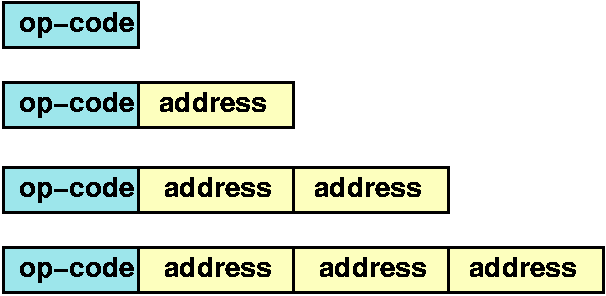
Some instructions have no address arguments some need one address some need two. Fixed-length instruction is fast and results in better performancewhen instruction levelpipelining is used. For targets that support variable length instructions then there will be multiple decode tables to parse through and memory may have to be read multiple times before a successful decode occurs.
The instructions that are given to the CPU consist of the op code and one or more operands. The instruction pointer is. X86 instructions are variable-length which means that common instructions typically have a shorter encoding and so take up less space in instruction cache.
For variable-length data types the provider must rely on the consumer to specify how much memory must be allocated for the data. What two reasons explain why instructions tend to be variable length. The instruction thus fed to the system can be of two types.
Some bits are wasted for some instruction types Load-store Register-register architecture Permits very fast implementation of simple instructions Easier to pipeline Chapter 6. It simplifies the process of instruction fetching. The consumer does this by setting the value of cbMaxLen appropriately.
1 - 16 bytes. If all instructions were set at a sufficiently large fixed length to accommodate these there would be a lot of wasted space in the instruction code. A RISC instruction set normally has a fixed instruction length often 4 bytes 32 bits whereas a typical CISC instruction set may have instructions of widely varying length 1 to 15 bytes for x86.
One of the advantages that x86 has over most RISC chips is instruction density. Fixed length data files can be created with record lengths in the range from 5 bytes to 65535 bytes. Compared to fixed-length codes FLCs VLCs can represent the same message with a lower bit rate thus having a better.
Fixed length instructions may be easier to parse but in general waste space. Variable-length data files are created with a defined minimum record length. When you use fixed-length records you need to make the record length equal to.
Variable length instructions can take less space than fixed-length instructions so a program compiled for the 8086 is usually smaller than the same program compiled for MIPS. Variable-length codes VLCs are widely used in media transmission. Examples of Content related issues.
Variable length instructions allows instructions to be compressed down to a smaller size. Note that choices mentioned above will affect how the instructions are encoded into a binary. A variable-to-fixed length code is a code that takes a string in cal X breaks it into pieces of variable length and replaces each piece into a word of fixed length.
Lempel-Ziv breaks its input into chunks where each chunk extends a word in the dictionary by one symbol. 8 242017 Original RISC view Fixed-length 32 bits for MIPS instructions that have only a few formats Simplifies instruction fetch and decode Code density is sacrificed. The 8086 encoding is variable length ranging from 1 to 18 bytes.
Essentials Of Computer Organization And Architecture 4th Edition Edit edition Solutions for Chapter 5 Problem 7RET. The minimum record length specifies the smallest data record that will be added to the file. Unforeseen Instruction Set Extensions The other reason is instruction set extensions.

Fixed Length Risc Vs Variable Length Cisc Instructions

Fixed Length Risc Vs Variable Length Cisc Instructions
Cda 4101 Lecture 22 Notes

Comments
Post a Comment